By Adv. Kanish Bangia
Family disputes, by their very nature, are deeply personal and emotionally charged. When a family unit breaks down, the ensuing conflict over matters such as divorce, child custody, maintenance, and property division can leave indelible scars. For decades, the primary recourse for aggrieved parties has been the traditional court system—litigation. However, the adversarial nature of litigation often exacerbates conflict, turning family members into combatants in a public forum.
In recent years, a more humane, efficient, and empowering alternative has gained significant traction and legal sanction in India: Mediation. This article, from a legal practitioner's perspective, explores the critical differences between mediation and litigation and argues for the former's pre-eminence in the delicate realm of family law.
The Adversarial Path: Litigation Explained
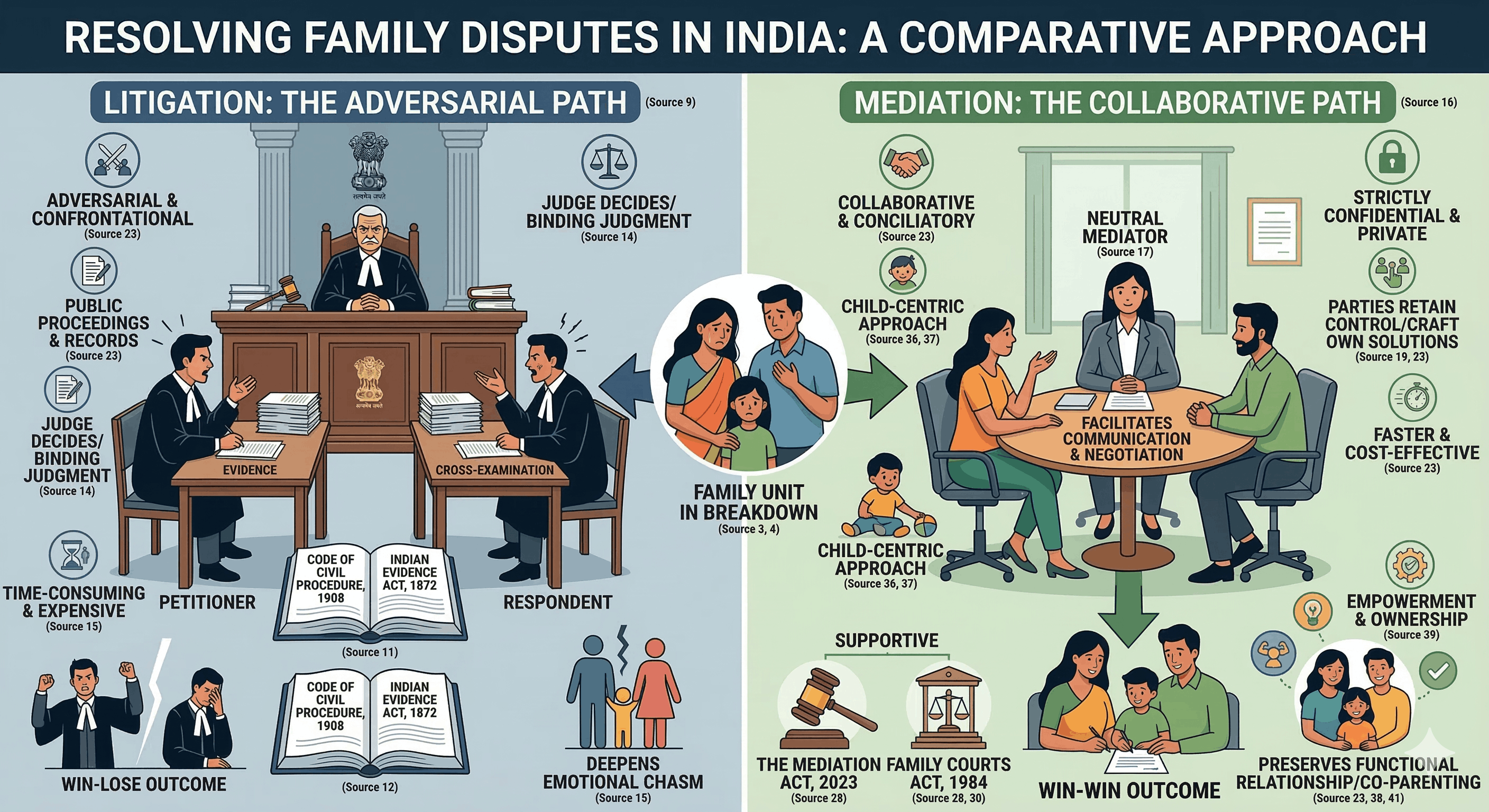
Litigation is the conventional, rights-based process of resolving disputes through the court system. In the context of family law, it involves one party (the Petitioner) filing a case against another (the Respondent) in a Family Court. The process is governed by rigid procedural laws, such as the Code of Civil Procedure, 1908, and the Indian Evidence Act, 1872.
The proceedings are adversarial, meaning each side presents its case, adduces evidence, and cross-examines the other's witnesses to discredit their claims. The ultimate decision rests with a judge, who delivers a binding judgment based on a strict interpretation of the law and the evidence on record. This process is inherently public, time-consuming, and expensive. More detrimentally, it often forces parties into a zero-sum game, where one party's victory is another's loss, thereby deepening the emotional chasm between them.
The Collaborative Path: Mediation Unveiled
Mediation is a structured, voluntary, and confidential process where a neutral and impartial third party, the Mediator, facilitates communication and negotiation between the disputing parties to help them reach a mutually acceptable agreement. Unlike a judge, a mediator does not impose a decision. Instead, the mediator’s role is to guide the parties towards identifying their underlying interests, exploring various options, and crafting their own solutions.
The focus in mediation shifts from past grievances and assigning blame to finding workable, forward-looking solutions. It is an interest-based approach that prioritizes the needs of the parties and, most importantly, the welfare of any children involved.
A Comparative Analysis: Mediation vs. Litigation
Understanding the key differences helps in choosing the right path:
Process: Litigation is adversarial and confrontational, while Mediation is collaborative and conciliatory.
Control: In Litigation, the judge and lawyers control the outcome. In Mediation, the parties retain control over the final agreement.
Confidentiality: Litigation involves public proceedings. Mediation is strictly confidential and private.
Time Frame: Litigation can take years due to backlogs. Mediation can be concluded in weeks or a few months.
Cost: Litigation is expensive (court fees, numerous hearings). Mediation is significantly more cost-effective.
Outcome: Litigation results in a win-lose judgment. Mediation leads to a win-win, mutually crafted settlement.
Impact on Relationship: Litigation often destroys goodwill. Mediation aims to preserve functional relationships, essential for co-parenting.
Flexibility: Court solutions are limited by law. Mediation allows for creative, practical solutions tailored to unique family needs.
The Legal Sanction for Mediation in India
The Indian legal system has progressively and robustly endorsed mediation as a primary tool for dispute resolution, particularly in family matters:
The Code of Civil Procedure, 1908: Section 89 empowers courts to refer pending civil disputes to ADR mechanisms, with mediation being most prominent. This solidified the legal foundation for court-annexed mediation.
The Family Courts Act, 1984: Enacted to promote conciliation and speedy settlement. Section 9 casts a duty upon the Family Court to make efforts for settlement first.
The Mediation Act, 2023: A watershed legislation establishing a comprehensive framework. It mandates pre-litigation mediation for civil and commercial disputes, lending institutional support.
Judicial Precedent: Courts consistently champion settlement. In Amardeep Singh vs. Harveen Kaur, the Supreme Court noted that statutory cooling-off periods for divorce could be waived if parties settled through mediation.
The Superiority of Mediation in Family Disputes
Beyond procedural benefits, mediation offers profound advantages:
A Child-Centric Approach: Mediation allows parents to collaboratively create parenting plans that prioritize the child's well-being, helping them transition from spouses to co-parenting partners.
Empowerment and Ownership: Parties are active architects of their own future, which increases the likelihood of long-term compliance.
Preservation of Dignity: Sensitive personal matters are discussed in a safe, private environment, avoiding public scrutiny and cross-examination.
Future-Focused Resolution: Encourages parties to concentrate on building a functional future rather than dissecting past wrongs.
The landscape of family law in India is undergoing a paradigm shift, moving from a culture of adversarial litigation to one of collaborative resolution. While the courts remain the ultimate arbiters of justice, mediation offers a more constructive, compassionate, and efficient first port of call for families in crisis. It upholds the dignity of the individuals, protects the welfare of the children, and provides a platform for healing and moving forward. For legal practitioners and disputants alike, embracing mediation is not merely choosing an alternative; it is choosing a better, more civilized path to resolving the most personal of human conflicts.